
.jpg)
Northern lights tour with photos, Fairbanks (Arctic Night Tours)
The most-reviewed northern lights tour in GetYourGuide's Fairbanks listings when we checked, with photos of you under the aurora included.
- 4.9★ (262 on GetYourGuide)
- Photos included
Home › Best places
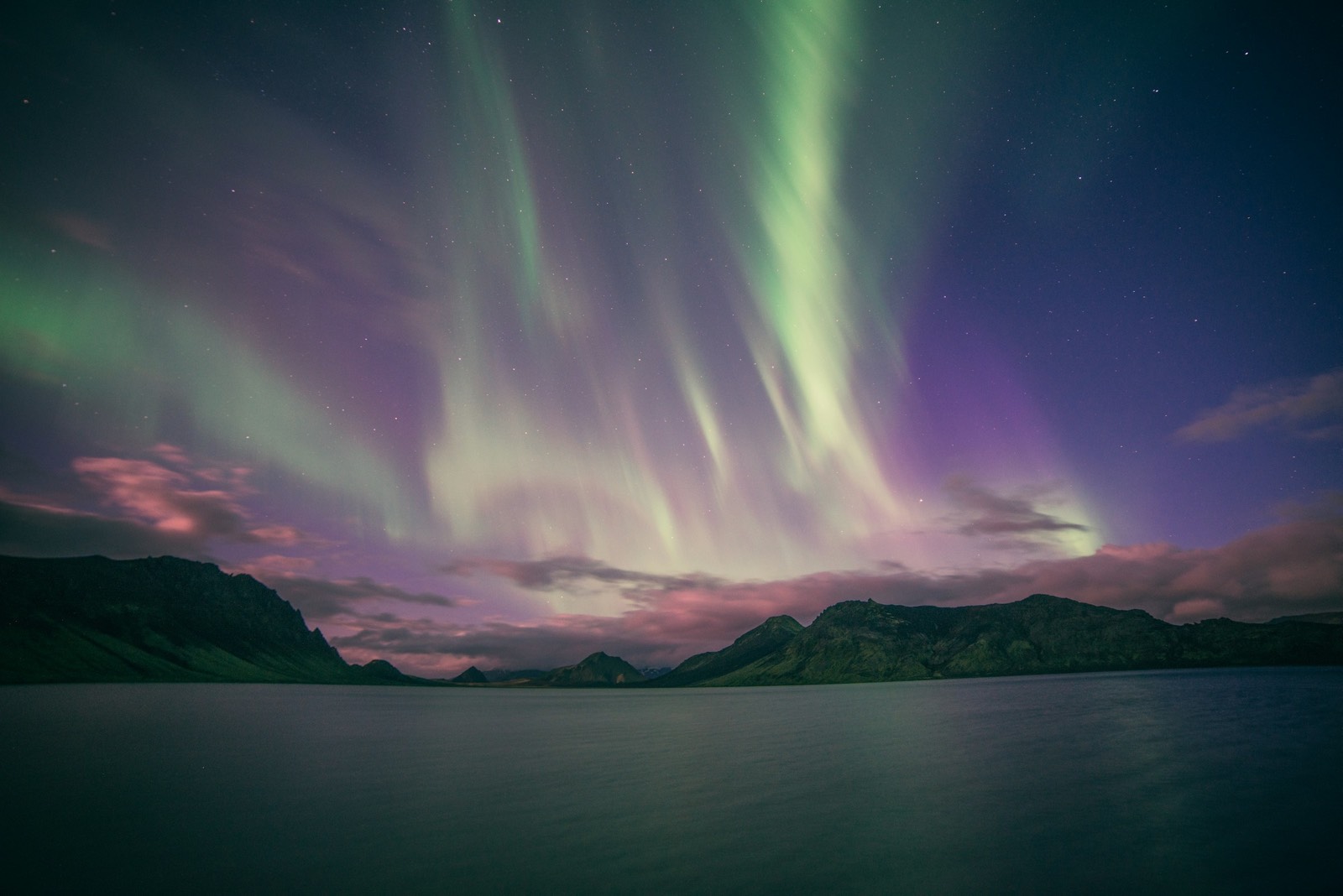
Álftavatn, Iceland. Photo: Jonatan Pie, Unsplash License · 10-second exposure: brighter than the eye sees
For a first trip, Iceland. For the best measured odds in Europe, Abisko in Sweden. For Americans, Fairbanks in February or March.
We ranked six places by one test: how likely you are to come home happy. That means two things. The chance of a clear night with the aurora overhead, and what the trip gives you when the sky stays shut.
Where a figure comes from real weather records, we say measured. Where it comes from a weather model, we say modelled. We never rank one against the other as if they were the same thing.
Some links on this page go to booking partners. If you book through them we may earn a commission at no extra cost to you. It never changes what we recommend. How we make money
Two things, and neither is how far north a place looks on the map.
The auroral oval
The aurora lives in a ring around the magnetic pole.
Clear sky
Once you are under the oval, cloud decides almost everything.
Iceland is the easy yes. Reykjavík is inside the oval, so a quiet night can still bring a green arc across the northern sky. You don't need a storm.
And if the weather shuts you in, you are still in Iceland:
The catch is cloud.
There is no clear month. Weather often differs across the country, so a car or a tour that chases gaps should do better than staying put, though by how much is our estimate, not a measurement.
The odds are measured at two airports near Reykjavík and are slightly optimistic, because the reports miss thin high cloud (how we work them out).
Start with northern lights in Iceland and the best time to go.
The cold is milder than people expect
Reykjavík's coldest month averages +0.7°C. Pack for wind and rain, not for −30.
Tromsø is the one place on this list where the aurora comes with a proper city: 79,943 people, restaurants, a cable car, fjords and mountains. It sits at about 67.5° geomagnetic by our calculation, inside the oval. Here you don't need a storm, you need a hole in the cloud.
The cloud is the problem, and the chase is the answer. Tromsø is coastal and often socked in, so the local industry drives out of its weather every night.
| What | The detail | Cost |
|---|---|---|
| Minibus aurora chase | 7–9 hours; per the operator's listing on Visit Tromsø, may travel more than 200 km or cross into Finland or Sweden | roughly 1,000–2,300 NOK a night |
| Whale watching (by day) | November to January; now a full day out to Skjervøy | about 2,000 NOK |
| Cable car | Climbs to 421 m and stays open until midnight | 645 NOK return |
Odds, modelled only. A weather model (NASA MERRA-2, via WeatherSpark) puts Tromsø at 21–24% of the time “clear, mostly clear or partly cloudy” from November to March. Partly cloudy counts as clearer there, so real clear sky is lower. No measured night-by-night record was available to us.
It is getting busy
January hotel nights in Troms county are up about 60% since 2017, and February 2026 was the busiest winter month on Statistics Norway's record. The Tromsø Ice Domes are closed for 2026/27.
Fairbanks sits under the edge of the oval, about 65.6° geomagnetic by our calculation, in the Alaskan interior behind the Alaska Range. It has the thing no European rival can copy: an outdoor hot spring at Chena, 106°F water in −30°F air, with the aurora overhead on a good night. Add a permanent ice museum, dog teams, and a 15-hour winter drive up the Dalton Highway to the Arctic Circle.
Odds, measured: we matched 26 winters of hourly reports from Fairbanks airport to the geomagnetic record, night by night.
What that means for how long to stay:
See the best time in Alaska, and plan it with the Fairbanks guide.
The cold is real
January averages a low of −27°C (−17°F) at the airport, and it hits −40°F on about seven days a year. March is kinder: an average high of −4°C (25°F).
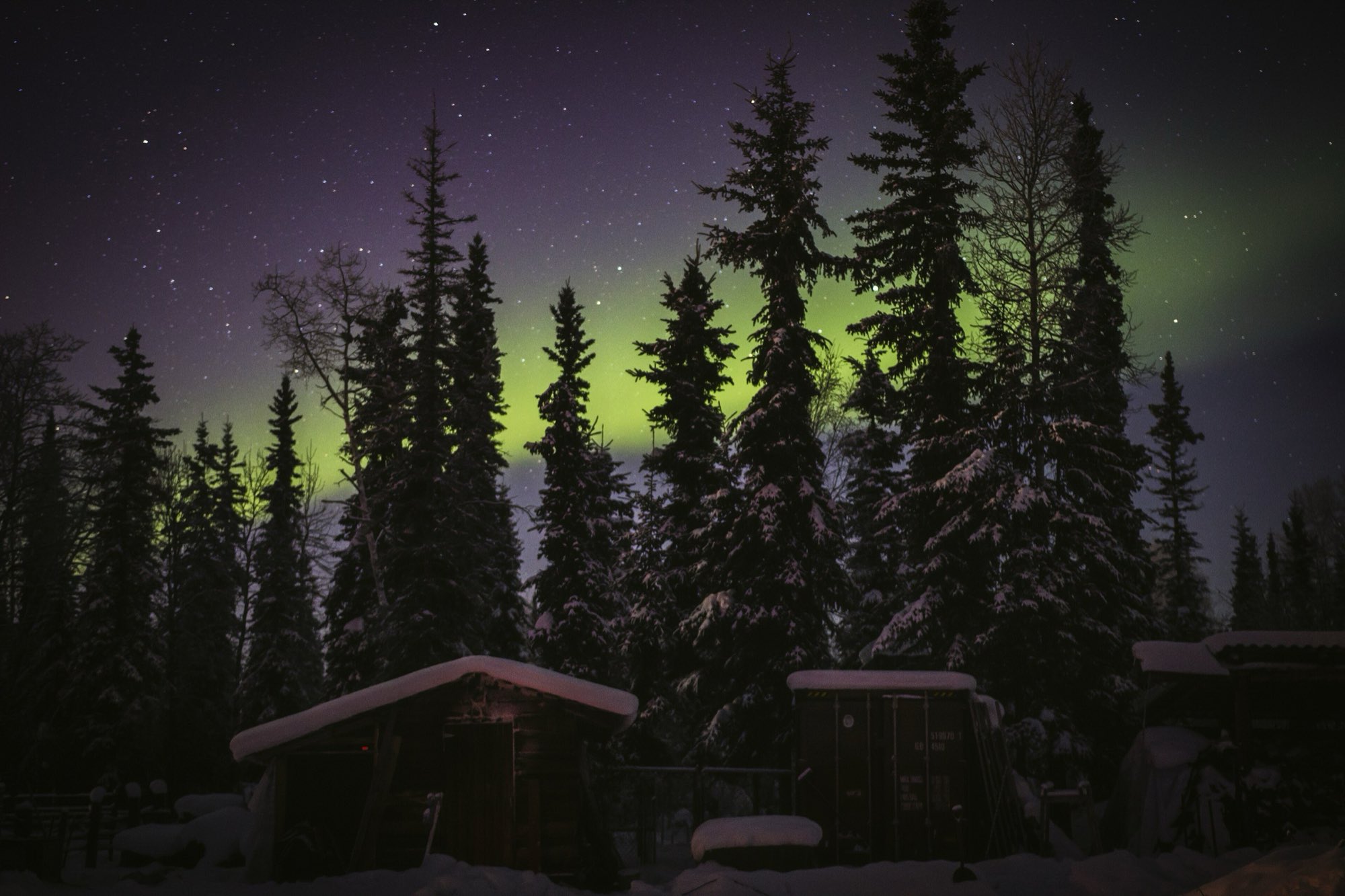
Abisko is a hamlet of about 85 people in the Swedish mountains, inside the oval at 66.3° geomagnetic. It sits in a rain shadow: 311 mm of precipitation a year, against 1,003 mm at a station 20 km west.
Its set piece is the Aurora Sky Station:
Odds, measured: we worked from seven winters of hourly cloud readings at the Swedish weather service's Abisko station, joined night by night to the geomagnetic record.
Two honest corrections to what you'll read elsewhere
It is still the best-measured bet in Europe, and the rain shadow is real.
Yellowknife sits on Great Slave Lake, directly beneath the oval according to Spectacular NWT, the territory's tourism body. The experience is heated Dene teepees outside town, ice roads you drive on, and in March a castle built of snow on the frozen bay.
Odds, measured, but a different measure: Environment and Climate Change Canada's 1981–2010 normals count hours with the sky effectively clear (0–2 tenths cloud).
These are all hours of the day, not aurora hours, so they can't be ranked against the Abisko or Fairbanks figures.
Operators who keep nightly logs report a 90–98% chance of a sighting over three nights; Aurora Village, which publishes a nightly photo log, says 95%. Those are the operators' own figures, not independent ones.
The cold is the hardest on this list
The wind chill drops below −40 on about 44 days a season, and in January it reaches −30 or worse on 24 days out of 31. Operators rent full down kit, so you don't need to own it.
Rovaniemi is the easiest Arctic trip in Europe. It is also the only place here with no polar night: on 21 December the sun still rises at 10:58 and sets at 13:31.
What there is to do:
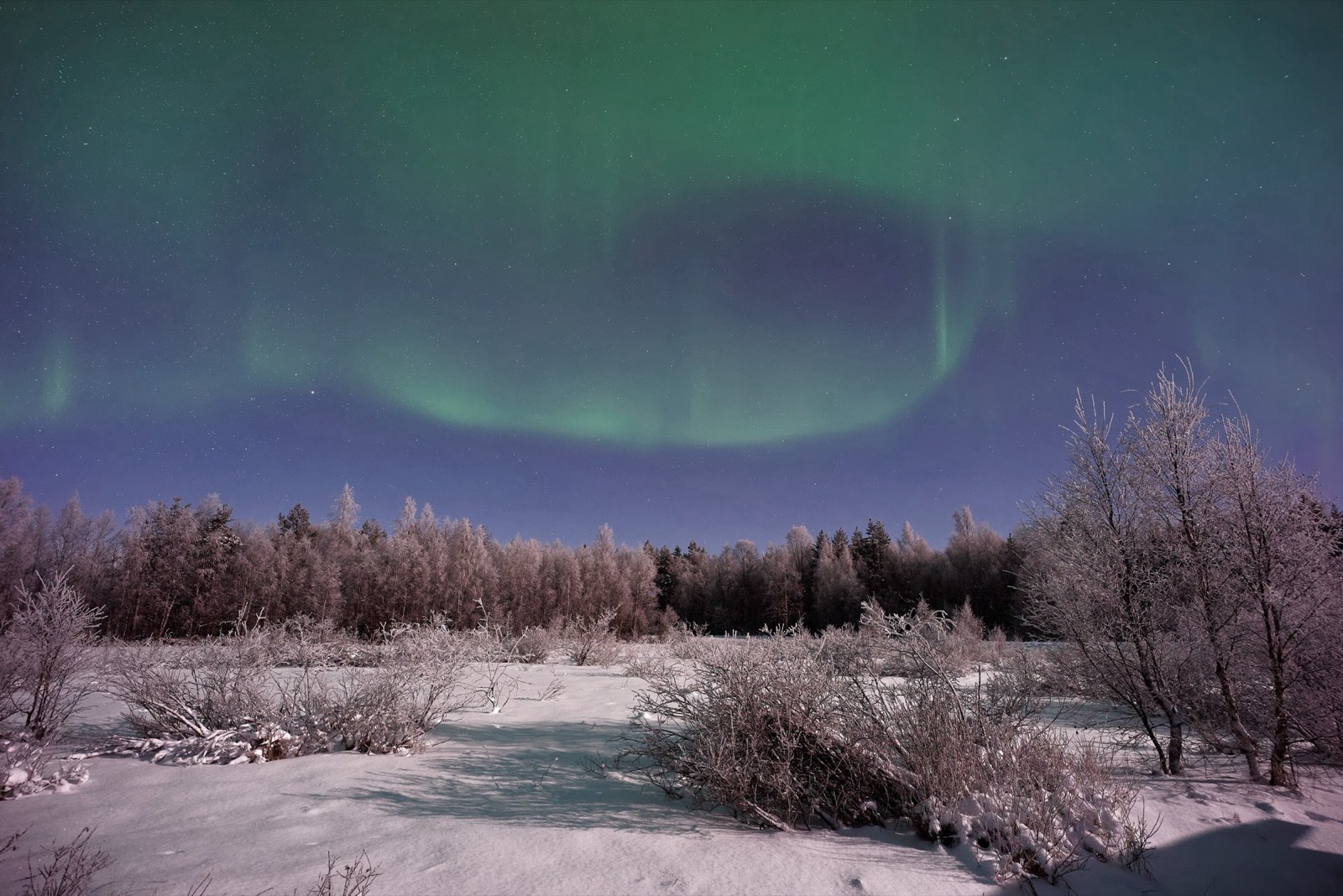
For the aurora it is the weakest of the six. At 63.6° geomagnetic it sits below the quiet oval, so the aurora often shows as a glow on the northern horizon rather than overhead.
The Finnish Meteorological Institute says Sodankylä, 120 km north, sees the aurora on about every second dark, clear night; Rovaniemi isn't on its list. Cloud, modelled only: WeatherSpark's model puts December and January at 83–84% overcast or mostly cloudy.
The fix is to go north
Spend at least two nights further up, around Saariselkä (about 68.4°N, some 250 km north).
| Place | Geomagnetic latitude | Sky evidence, and how it was gathered | Best months | Cost level | Getting there | Right for | Wrong for |
|---|---|---|---|---|---|---|---|
| Iceland (Reykjavík) | 68.9° | Measured, night by night: 48% of nights with a clear hour at Reykjavík airport, 38% at Keflavík, Sep–Apr | Sep–Mar | 173 (Iceland) | ~3 h from London, ~5 h from Boston | A first aurora trip; anyone who wants a holiday even if they never see it | Anyone expecting clear skies |
| Tromsø | 67.5° | Modelled: 21–24% of the time “clearer” Nov–Mar, partly cloudy included | Sep–Mar | 140 (Norway) | Via Oslo; no US nonstop | People who want a real place; whales; a professional driver chasing clear sky | Anyone hoping to look up from the hotel |
| Fairbanks | 65.6° | Measured, night by night: 45% of Feb and 49% of Mar nights clear | Late Feb–Mar | Not in index | Nonstop from Seattle; 17–22 h from London | Americans; hot-spring soakers; anyone who can go in February or March | Europeans on a short break |
| Abisko | 66.3° | Measured, night by night: 52% of nights with a clear hour, Sep–Mar | Nov–Feb | 123 (Sweden) | Stockholm–Kiruna, then ~100 km; or night train | People whose only goal is the aurora; anyone happy reading through short grey days | Anyone who needs a town, restaurants or much to do in daylight |
| Yellowknife | under the oval (Spectacular NWT) | Measured, all hours: 38% clear in March, 12% in October | Mar, Dec–Feb | Not in index | Via a Canadian hub; daily from Vancouver | A clear late-winter sky; people who can take real cold | Anyone who needs daytime life or minds −40 |
| Rovaniemi | 63.6° | Modelled: 83–84% overcast or mostly cloudy Dec–Jan | Sep, Mar | 122 (Finland) | Direct from 6+ UK airports | Families; a first Arctic trip; a budget | A trip where the aurora is the whole point |
Why we don't rank most of the cloud figures against each other. Abisko, Fairbanks and Iceland were measured the same way: hourly station reports, night by night, joined to the geomagnetic record. At a proper display, three nights in Reykjavík (52–58%) sits a little below Abisko (53–65%) and above Fairbanks from September to December. Yellowknife's counts every hour of the day. Tromsø's and Rovaniemi's come from a weather model that counts “partly cloudy” as clearer. Put them in one league table and you'd be comparing different things. How we work out the odds explains each method.
Wherever you go, the number of nights matters more than the place. See how many nights you need and the best time to go.
A guide who reads the cloud map and drives to the gaps is the single biggest upgrade on a short trip. Two starting points; more in our guide to choosing a tour.
The most-reviewed northern lights tour in GetYourGuide's Fairbanks listings when we checked, with photos of you under the aurora included.
Minibus · From Reykjavík
A minibus tour out of Reykjavík's city lights. Check the group size, pickup and re-try policy on the listing before you book.
Fairbanks price as shown on GetYourGuide for 15–20 Feb 2027 (₹21,504), converted at ₹95.54 per US$, the rate the booking sites themselves applied on 23 Sep 2026.
It depends on what you want from the trip. For a first trip, Iceland: inside the auroral oval, a short flight, and a holiday even if it's cloudy. For the best measured odds in Europe, Abisko in Sweden. For Americans, Fairbanks in February or March.
Both sit inside the auroral oval and both are cloudy coasts, so neither has a clear odds advantage we can prove. Iceland has more to do by day and is easier to self-drive. Tromsø has a real city and a chase fleet that drives into Finland or Sweden for clear sky.
Fairbanks, Alaska, in late February or March. In those months 45–49% of nights have a clear spell, against 26–27% in September and October, from 26 winters of airport records.
Yes, but less often than further north. Rovaniemi sits below the quiet auroral oval, so the aurora often appears low on the northern horizon, and December and January are very cloudy. Spend two nights further north, around Saariselkä, if the aurora matters.
No. The current solar cycle peaked in October 2024. Activity is still high, though: from January 2024 to September 2026, 32.6% of evening 3-hour periods (21:00–03:00 UT) reached Kp 3, against 23.1% over the same stretch around the previous cycle's peak (mid-2013 to early 2016): about 40% more, by our count from the GFZ Kp record.
Of the European options, Finnish Lapland and Swedish Lapland. On restaurants and hotels, Finland scores 122 and Sweden 123 against Norway's 140 and Iceland's 173 (EU average 100, 2025).