.jpg)
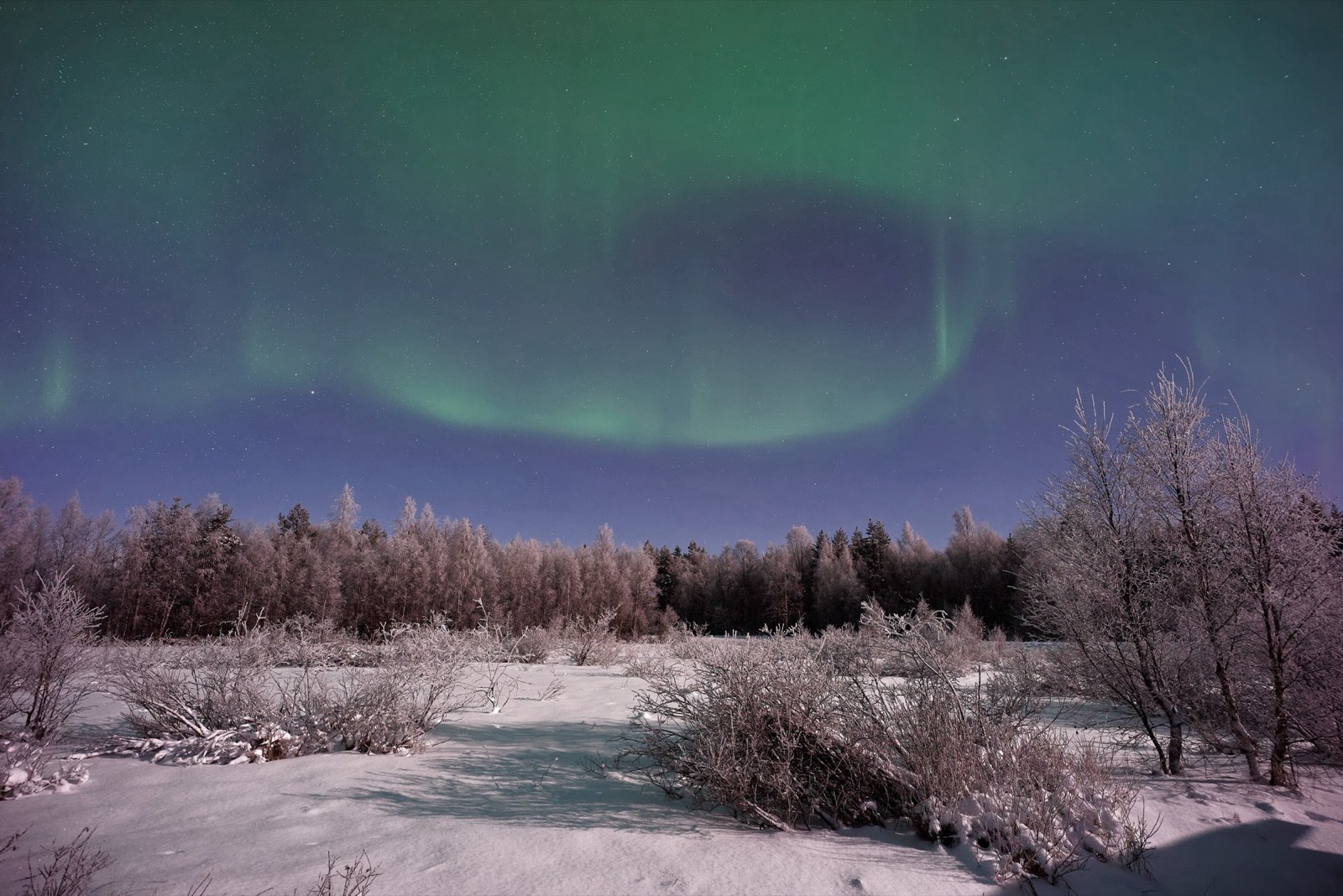
Three nights gives roughly even odds of a proper display at Abisko in any month from September to March, staying in Reykjavík in any month, and at Fairbanks in February or March. For an 80% chance, plan six to eight nights at Abisko, or eight to nine at Fairbanks in February–March. No normal trip can promise a strong overhead show.
Most guides answer this with a guess, or with a formula that treats every night as a fresh roll of the dice. We counted instead. We took real weather records from two aurora towns, Abisko in Sweden and Fairbanks in Alaska, and from two airports near Reykjavík in Iceland, matched every clear hour to the geomagnetic record, and looked at every real run of consecutive nights. Cloudy spells included.
Three kinds of night
Seeing “the northern lights” can mean very different things. We split it three ways, by the Kp geomagnetic index during a clear hour.
Faint
Kp 1 or more
- A pale arc, often low in the northern sky
- Easy to miss, easy to mistake for cloud
- The camera sees it better than you do
A proper display
Kp 2 or more
- A clearly visible arc or band that moves
- The Icelandic Met Office puts it well: even grade 2 “can be beautiful”
Strong and overhead
Kp 3 or more
- The curtains and colour you've seen in photos
- In the Met Office's words, grade 3 “can be dazzling”
A good night in the tables below means at least one clear hour in the evening window while activity was at that level. Full definitions, data sources and limits are on how we work out the aurora odds.
The headline numbers
Chance of at least one good night, all months of the season together.
| Place | Faint: 3 nights | Faint: 4 nights | Proper: 3 nights | Proper: 4 nights | Strong: 3 nights | Strong: 4 nights |
|---|---|---|---|---|---|---|
| Abisko, Sep–Mar | 77% | 85% | 58% | 67% | 33% | 40% |
| Fairbanks, Sep–20 Apr | 56% | 65% | 41% | 49% | 24% | 29% |
| Reykjavík, Sep–20 Apr | 70% | 78% | 56% | 64% | 34% | 41% |
| Keflavík, Sep–20 Apr | 58% | 67% | 45% | 54% | 26% | 32% |
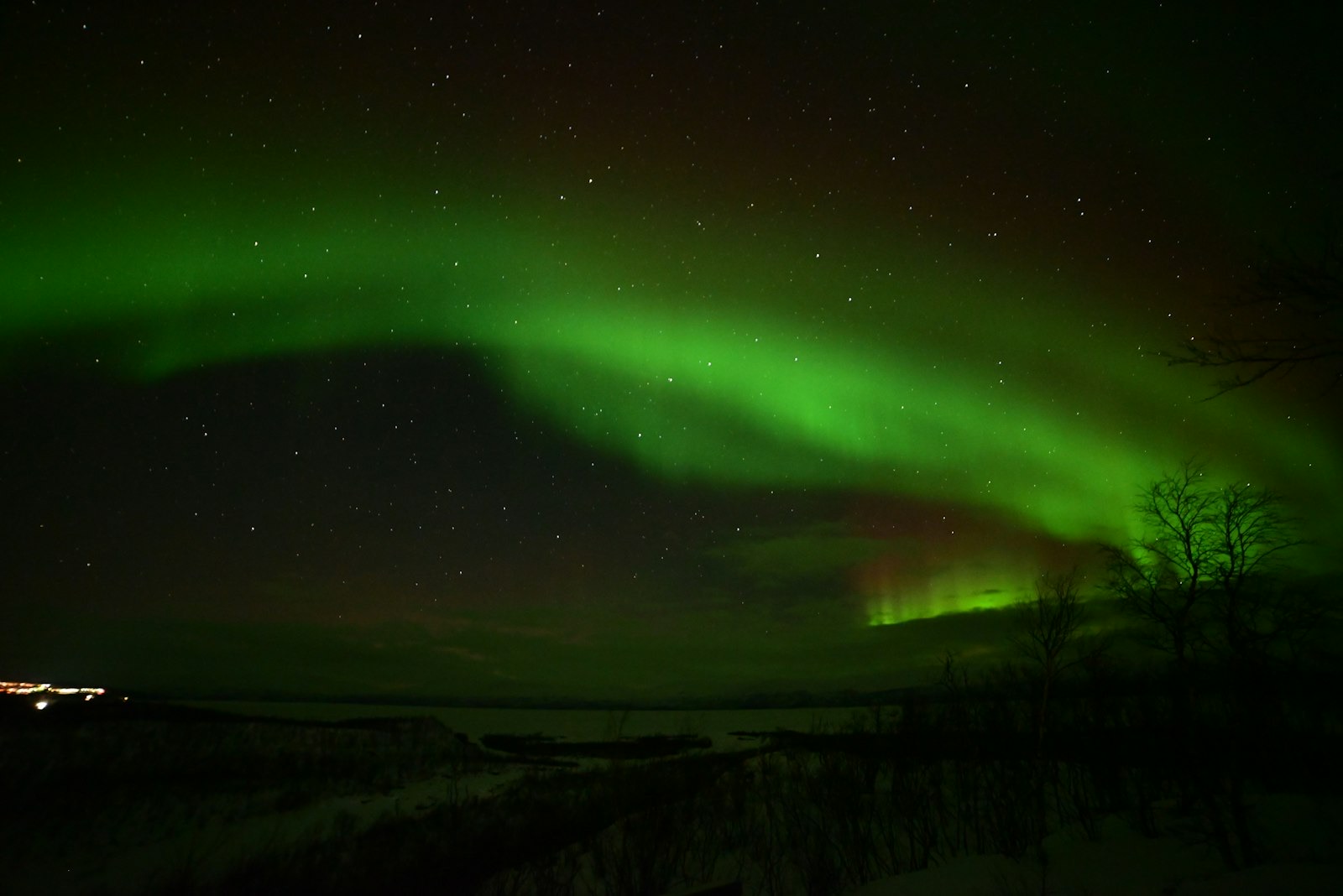
Abisko, month by month: a proper display
| Month | Chance within 3 nights | Nights for 50% | Nights for 80% | 80% range across winters |
|---|---|---|---|---|
| September | 53% | 3 | 8 | 5–12 |
| October | 56% | 3 | 7 | 5–9 |
| November | 59% | 3 | 6 | 5–9 |
| December | 55% | 3 | 7 | 5–10 |
| January | 62% | 2 | 6 | 4–9 |
| February | 65% | 2 | 6 | 4–8 |
| March | 56% | 3 | 6 | 5–9 |
Fairbanks, month by month: a proper display
| Month | Chance within 3 nights | Nights for 50% | Nights for 80% | 80% range across winters |
|---|---|---|---|---|
| September | 35% | 6 | more than 14 | 12 to more than 14 |
| October | 33% | 6 | 14 | 11 to more than 14 |
| November | 39% | 5 | 13 | 8 to more than 14 |
| December | 36% | 6 | more than 14 | 12 to more than 14 |
| January | 43% | 4 | 11 | 8–14 |
| February | 50% | 3 | 8 | 7–9 |
| March | 52% | 3 | 9 | 7–11 |
| April (to the 20th) | 44% | 4 | 9 | 7 to more than 14 |
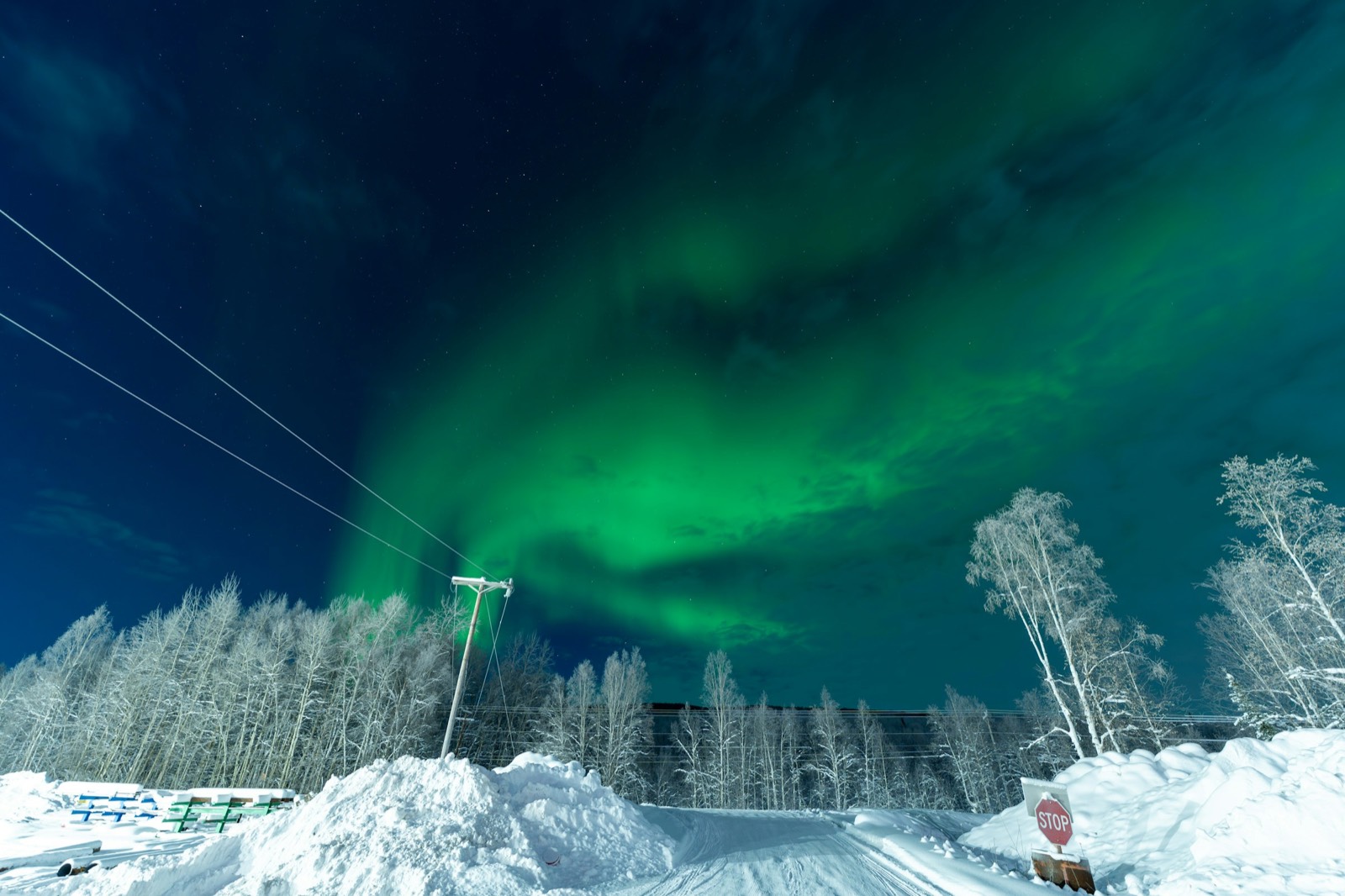
What the Abisko and Fairbanks records show
Abisko is steady
- A proper display within three nights is better than even in every month
- Six to eight nights gets you to 80%
- January and February are the best months
Fairbanks is a late-winter destination
- In February and March it comes close to Abisko: three nights is about even, and eight or nine nights reaches 80%
- From September to December it is a different trip: the same 80% takes 13 nights or more
- That's because only about a quarter to just over a third of autumn nights are clear
For when to go in Alaska, that is the whole story: go in February or March.
Why simple maths overstates your odds
The usual shortcut: if a night has a 36% chance, three nights must give 1 − 0.64³, about 74%. That assumes each night is independent.
Weather isn't. A storm system can sit over a valley for four nights, then clear for three. Bad nights come in runs, and so do good ones.
So we didn't use the formula. We counted every real run of three, four or more consecutive nights in the records and asked how many contained a good night. The real answer is lower in almost every month and at every level: at Fairbanks in March, the formula says five nights for 80%; the real runs say nine. The full side-by-side is on how we work out the aurora odds.
Iceland, month by month: a proper display
Staying in the Reykjavík area. Each cell gives Reykjavík first, then Keflavík, the conservative figure.
| Month | Chance within 3 nights | Nights for 50% | Nights for 80% |
|---|---|---|---|
| September | 56% · 51% | 3 · 3 | 7 · 8 |
| October | 56% · 46% | 3 · 4 | 7 · 10 |
| November | 52% · 43% | 3 · 4 | 10 · 12 |
| December | 55% · 42% | 3 · 5 | 8 · 11 |
| January | 58% · 46% | 3 · 4 | 7 · 10 |
| February | 55% · 48% | 3 · 4 | 7 · 10 |
| March | 58% · 47% | 3 · 4 | 6 · 9 |
| April (to the 20th) | 54% · 39% | 3 · 5 | 7 · 10 |
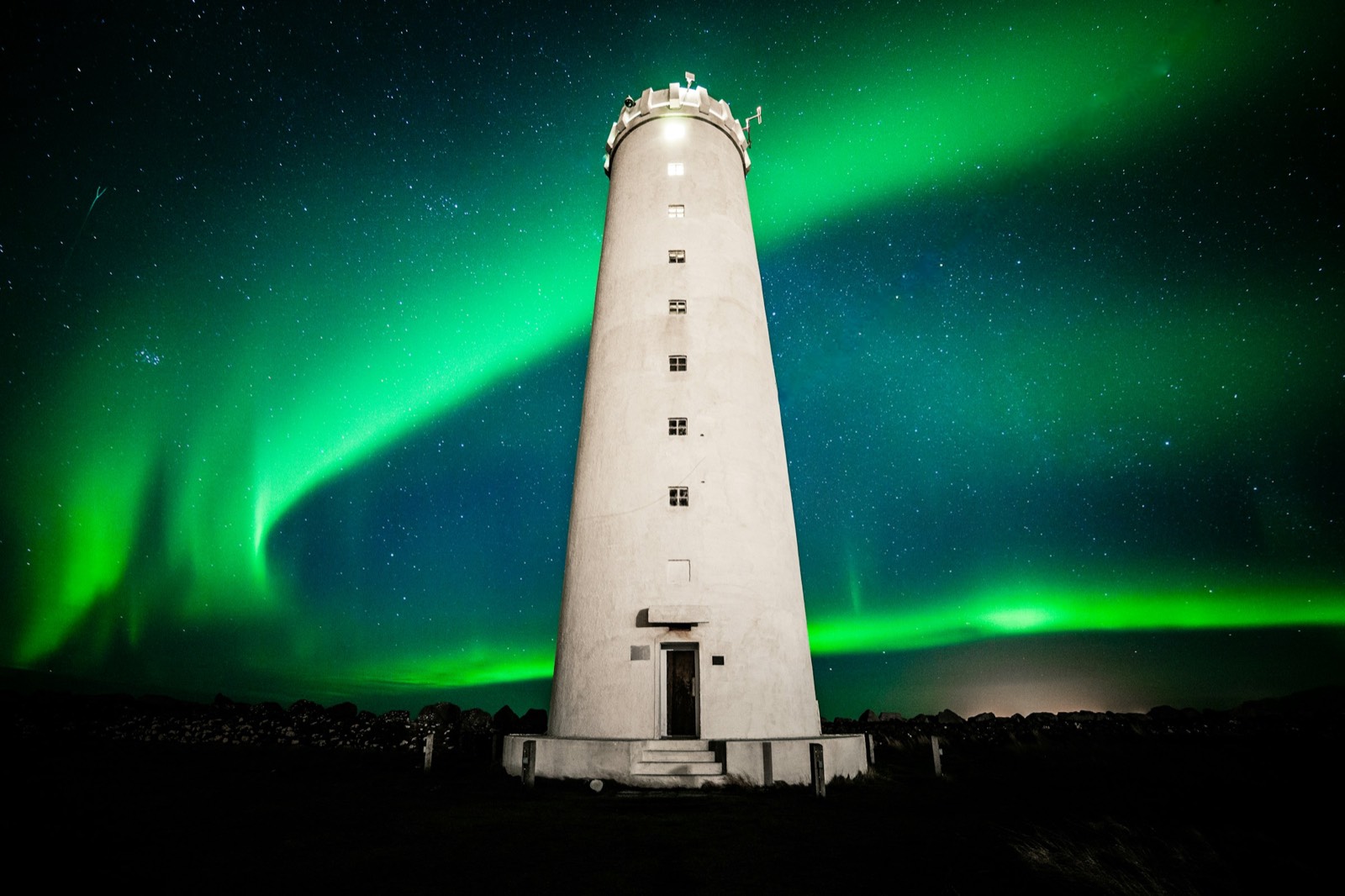
Iceland at Kp 2 sits a little below Abisko (three nights: 52–58% in Reykjavík, 42–51% at Keflavík, against 53–65% at Abisko, September to March), and above Fairbanks from September to December. No month stands out for cloud.
Tromsø, Rovaniemi and Yellowknife
We only have night-by-night records for Abisko, Fairbanks and Iceland, so only those are counted this way.
Yellowknife
Operator figures
- Operators who keep nightly logs report a 90–98% chance of a sighting over three nights
- Aurora Village, which publishes a nightly photo log, says 95%
- These are the operators' own numbers, not independent ones, and they count any sighting
Tromsø and Rovaniemi
Modelled cloud only
- We have only modelled cloud for both, so we don't publish a nights figure for either
What to do with this
- Book more nights, not more tours. A flexible, longer stay beats an extra excursion on a short one. Whatever simple odds suggest, add one or two nights.
- Go every clear night. Displays often come in bursts of minutes, not a steady show. Check the forecast and the cloud map each evening, be ready to go out, and be patient once you're there. If you want a picture, read how to photograph the northern lights on a phone before you go.
- Don't expect the big show. A strong overhead display within three nights is 26–40% at Abisko depending on the month, 29–39% staying in Reykjavík (18–35% at Keflavík), and 18–35% at Fairbanks. If it happens, it's a gift, not a plan.
Pick the month first. At Fairbanks, the same three nights give:
One retired figure
You may see “nine nights in March for 80%” quoted, including in our own early notes. It came from treating clear hours as clear nights and assuming nights are independent. Several errors that happened to cancel each other out. The tables above replace it.
How we worked this out
We joined every hourly cloud reading from the Swedish weather service's Abisko station (2019–2026) from Fairbanks airport (2000–2026) and from Reykjavík and Keflavík airports (2012–2026) to the GFZ Kp index, hour by hour, and counted every real run of consecutive nights in each month. The full method, the faint and strong tables for Abisko, and the limits of the data are on how we work out the aurora odds.
How many nights: common questions
Is 3 nights enough to see the northern lights?
It gives you a real chance, not a likely one. Three nights gives a 53–65% chance of a proper display at Abisko, depending on the month, 52–58% staying in Reykjavík, and 50–52% at Fairbanks in February or March. For about 80%, plan six to eight nights at Abisko, or eight to nine at Fairbanks in February–March.
Can you see the northern lights in one night?
Yes, if you're lucky. At Abisko about 28% of season nights have a clear hour with a proper display; in Fairbanks about 20% of nights, and closer to 30% in March; in Reykjavík about 28% (21% at Keflavík).
How many nights do you need in Iceland?
Staying in Reykjavík, three nights gives a 52–58% chance of a proper display depending on the month, and 6–10 nights gives about 80%. Keflavík, the conservative figure, needs 8–12. These are measured from airport weather reports, 2012–2026, and slightly optimistic because the reports miss thin high cloud. A strong show within three nights is 29–39% in Reykjavík. Driving to clear sky should help, but that part is our estimate, not a measurement.
How many nights do you need in Fairbanks?
In February or March, three nights gives about even odds of a proper display, and eight to nine nights about 80%. From September to December, even odds take five or six nights, so plan far longer, or pick another month.
Do tour operators guarantee the northern lights?
No one can guarantee the sky. Some operators offer a free retry if you see nothing, which only helps if you have another night in the country.
Pick the month and the place
Sources (8)
- SMHI: hourly cloud, station 188790 Abisko Aut, corrected archive (checked 2026-09-23)
- Iowa Environmental Mesonet: Fairbanks airport (PAFA) weather reports, 2000–2026 (checked 2026-09-23)
- Iowa Environmental Mesonet: Reykjavík (BIRK) and Keflavík (BIKF) airport weather reports, 2012–2026 (checked 2026-09-24)
- GFZ Potsdam: Kp index since 1932 (checked 2026-09-23)
- Icelandic Met Office: aurora forecast and how to read it (checked 2026-09-17)
- Aurora Village: aurora viewing and nightly photo log (checked 2026-09-17)
- Spectacular NWT: the northern lights by the numbers (checked 2026-09-17)
- Our calculation: nights-needed method and results, Northern Lights Planner, 23 September 2026